
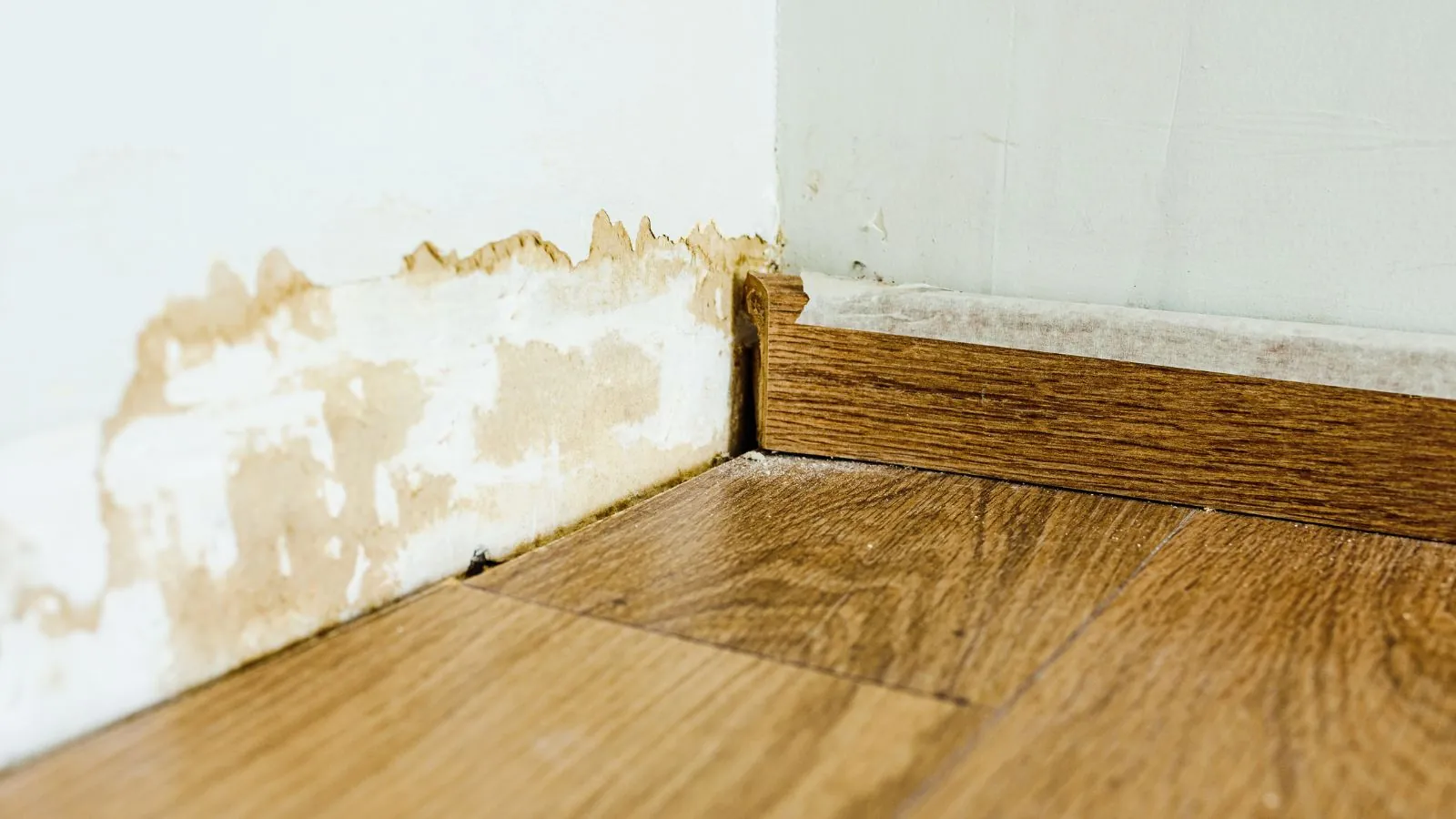
Wall and drywall water damage repair covers painted drywall, plaster and the insulation and framing behind them. Water enters from a leak in the wall, a roof or window leak, a flood or a burst pipe, and it spreads along the bottom of the board and up the paper face.
Repairs need two phases. First comes drying and removal of failed material. Second comes patching, texturing and painting. Many homeowners skip the first phase, which is why stains and mold come back. For the drying stage, see structural drying and dehumidification.
How to tell if drywall can be saved
Drywall that is only damp and was wet with clean water for a short time can often be dried in place with air movers and cavity drying. Drywall that has sagged, crumbled, turned soft or been soaked by Category 2 or 3 water is generally cut out because the gypsum core loses strength and can grow mold.
A crew will measure the wall with a meter and may drill small test holes behind baseboards. A common approach for contaminated water is a flood cut, which removes the lower part of the wall a measured height above the waterline. ANSI/IICRC S500 sets the water categories that decide whether wet drywall is dried in place or cut out.
Insulation, framing and what is behind the wall
Wet insulation does not dry well and often has to be removed. Fiberglass batts hold water against the studs, and cellulose and foam types behave differently. Studs and plates dry in place in most cases, and moisture readings tell the crew when they are ready for new board.
If a wall stayed wet for many days, check the back of the board and the framing for staining or mold. A musty smell near a baseboard is a warning even when paint looks fine.
What to do when a wall is wet
Stop the source
Shut off the water, fix the roof or window opening temporarily and keep the area dry.
Do not paint over a stain
Paint hides moisture and can trap it. Wait for a moisture check.
Open nothing yet
Avoid cutting the wall yourself unless you know what is behind it. Pipes and wires may be inside.
Pull furniture away
Move furniture a few inches away from the wall for airflow.
Check the baseboards
Look for swelling, staining and a damp feel at the base.
Photograph the wall
Capture stains and bubbling before anything is removed.
Patching, texture and paint
Once the wall is dry, new drywall is cut in, taped, mudded and sanded. Texture matching can be the hardest part of a repair, and a whole-wall repaint is often the only way to hide patches.
A stain-blocking primer helps keep old water stains from bleeding through. A coat of ordinary paint alone is not a repair. If the wall leaked from a pipe, the pipe must be fixed first.
Choosing a contractor for the rebuild
In Massachusetts, most residential home improvement work on one- to four-family owner-occupied homes must be done by a registered contractor, and the state Office of Consumer Affairs and Business Regulation runs a lookup for registrations. Contracts over $1,000 must be in writing. Check the registration before you sign, and keep the contract with your claim records.
| Sign | What it means | Next step |
|---|---|---|
| Brown ring on the paint | Past or slow leak | Find the source and check for moisture |
| Bubbling paint | Moisture behind the paint | Test and dry the wall |
| Soft or crumbling board | Gypsum core failed | Cut out and replace |
| Musty smell near baseboard | Wet insulation or mold | Open an inspection hole and check |
| Swelling at the base | Wicking of water | Dry the cavity and replace affected board |
Is a wall wet or stained?
Call and describe the stain, the room and what is on the other side of the wall.
What affects wall repair cost
Wall repairs depend on how much board comes out. These factors drive the cost.
Wall area affected
Larger areas need more tear-out, board and finishing.
Insulation and framing
Wet insulation adds removal and replacement.
Water category
Contaminated water leads to larger flood cuts.
Finish quality
Texture matching and a full repaint cost more than a spot patch.
Access
Tight spaces, tile and cabinets add labor.
Insurance often covers sudden water damage to walls and may exclude gradual leaks. Check your policy and ask your insurer. For your own scope, call (508) 286-8971.
Hiring a rebuild contractor in Massachusetts
Many water losses end with a rebuild, and the rebuild is where a registered contractor matters. The Massachusetts home improvement contractor law covers most residential work on one- to four-family owner-occupied homes, and registration can be checked online through the state's consumer affairs office.
Ask for the registration, a written contract and a scope that matches the drying and repair work in your restoration record. Call the Middleborough Building Department to ask whether your repair needs a permit.
Source type: Massachusetts Office of Consumer Affairs and Business Regulation, M.G.L. c. 142A
Frequently asked questions
Can wet drywall be dried instead of replaced?
Sometimes. Clean-water drywall that has not softened can be dried in place with air movers or cavity drying. Soft, crumbling or contaminated board is cut out.
Why did the stain come back after I painted?
The wall may still be wet, or the stain was not sealed with a stain-blocking primer. Check moisture first, then prime and repaint.
Do I have to cut the whole wall out?
Not usually. A measured flood cut or inspection holes often tell the crew how much to remove.
Is mold likely behind wet drywall?
It can be if the wall stayed wet for days. Musty smells or dark spots call for a check, and mold remediation explains how containment works.