
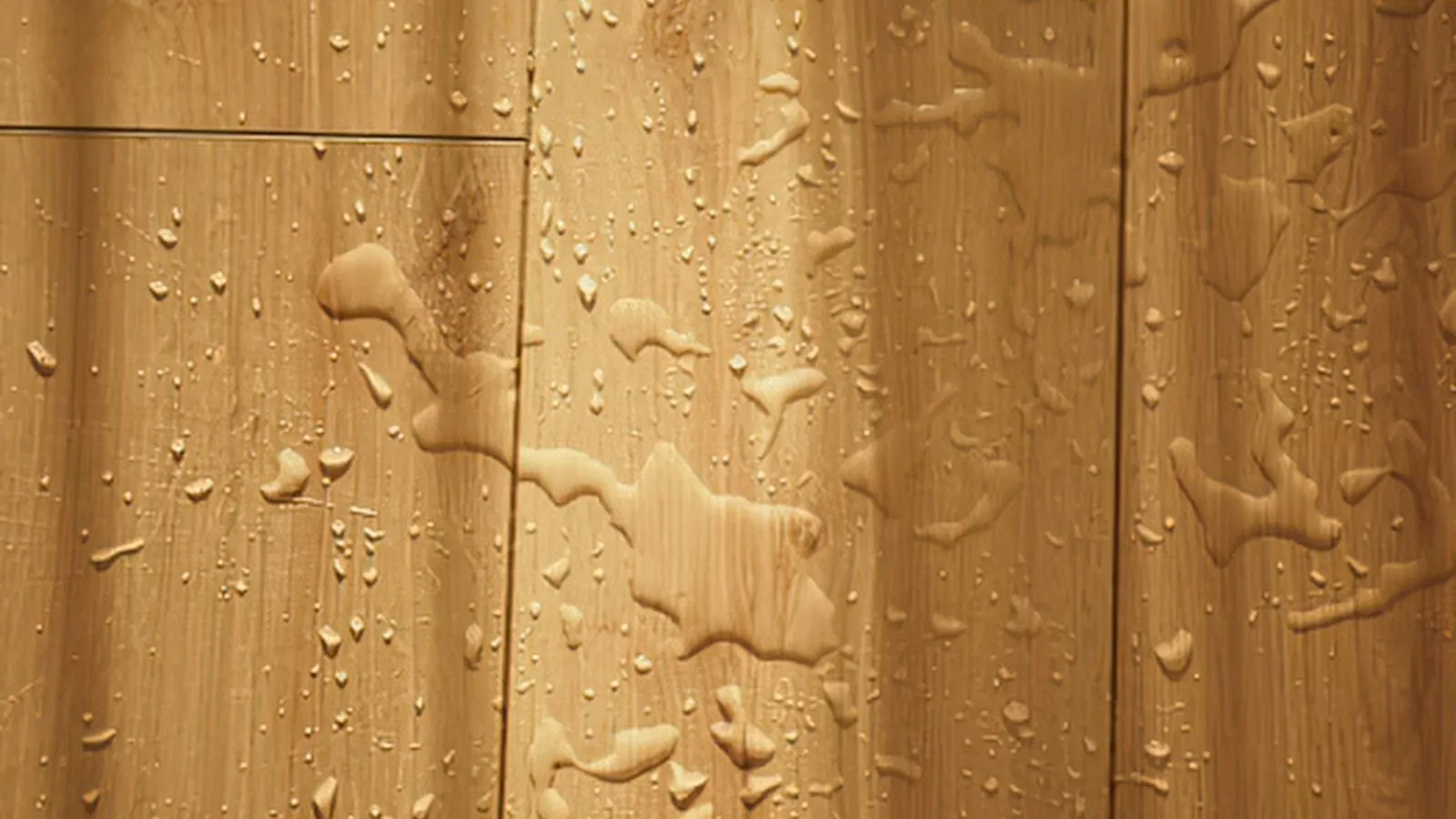
Hardwood floor water damage repair covers solid and engineered wood floors that have been wet from a leak, a spill that was not caught, a flood or humidity from a wet crawl space. Wood absorbs water through the edges and the underside, so the damage often shows up days after the leak.
The first job is drying, not sanding. Rushing to refinish a wet floor locks moisture in. For the equipment and monitoring side of the work, see structural drying and dehumidification.
What water does to wood floors
Wood swells as it takes on moisture. Boards that swell along their edges push against each other and rise at the center, which is called crowning, or they dry with raised edges, which is cupping. Severe moisture can lift boards off the subfloor in a buckle. Finishes can turn white or cloudy as water gets under them.
Solid wood and engineered wood behave differently. Solid boards can often be dried and flattened over time. Engineered planks have a thin top layer glued to plywood layers, and once that glue lets go, the planks usually cannot be saved. ANSI/IICRC S500 treats hardwood as a dense Class 4 material, so specialty drying and longer monitoring are normal, not an upsell.
Drying a hardwood floor
Hardwood floors dry slowly and need care. Crews use specialty mats and drying systems that pull moisture out through the surface, and sometimes remove a few boards or drill small holes to dry the subfloor. Moisture meters track the boards and the subfloor separately.
Heat is not the answer. Forcing a floor to dry too fast can make it crack and cup the other way. A staged approach with controlled airflow and dehumidification is safer. Expect days of monitoring, and expect some boards to stay raised until the whole floor equalizes.
What to do when a hardwood floor gets wet
Stop the source
Shut off the leak or appliance. Wipe standing water off the surface quickly, with towels, not a household vacuum.
Lift rugs and furniture
Move rugs, mats and furniture off the wet area. Place foil or blocks under legs if you cannot move them.
Avoid sanding or sealing
Do not sand or refinish a wet floor. It traps moisture and can ruin the finish.
Run the A/C or a dehumidifier
In humid weather, gentle air conditioning or a household dehumidifier helps until professional drying starts.
Do not use heat guns or space heaters
Fast heat can crack boards and cause severe cupping.
Photograph the damage
Capture the boards, the water source and any lifted edges. Photos support a claim.
Repair, refinish or replace
After drying, the floor is judged by its flatness and its finish. Mild cupping often relaxes and can be sanded flat and refinished. Boards that are cracked, buckled or stained black from long exposure are replaced, and new boards are blended into the old.
Pattern, species and finish matter for matching. A flooring contractor can often match the color after refinishing a whole room. For the full area, ask for repair, partial replacement and full replacement options in writing so you can compare them.
Hardwood over a crawl space or slab
Floors over a damp crawl space can cup slowly from moisture rising from below. Fixing the water source matters more than the floor itself, and a restoration crew will say if your floor problem is an ongoing moisture issue, not a one-time leak. See crawl space water damage for that situation.
| What you see | Likely cause | Usual outcome |
|---|---|---|
| Cupped edges within days | Moisture from below or a slow leak | Dry, wait, then sand and refinish if flat |
| Crowned boards | Surface water and fast drying | Re-evaluate after equalizing |
| Buckled boards | Heavy saturation | Remove and replace affected boards |
| Black stains | Long exposure or mold | Replace affected boards and check for mold |
| Delaminated engineered planks | Glue failure | Replace planks |
Is your hardwood cupping after a leak?
Call and describe the type of floor, the source and how long it was wet.
What affects hardwood floor repair cost
Floor repair varies from drying only to full replacement. These factors count.
Species and finish
Rare species and factory finishes are harder to match and cost more.
Solid or engineered
Engineered planks that delaminate generally cannot be saved.
Area affected
Whole-room repair costs more than a few boards but looks better.
Subfloor condition
Wet subfloor adds drying and sometimes replacement.
Refinishing scope
Sanding, staining and finishing a room is a separate job from drying.
Insurers often cover sudden floor damage from a burst pipe or appliance and may exclude long-term seepage. Check your policy, keep photos and ask your insurer. For your own scope, call (508) 286-8971.
Wet years and dry years in Middleboro
Wood floors move with humidity every year, and Middleboro's weather swings add to it. At the Plymouth airport station, rainfall averaged about 48 inches a year from 2000 to 2021, with 2018 near 61 inches and the dry year 2016 near 34 inches. The town's resilience report also records a drought in 2016 that followed the major flood of 2010.
For a hardwood floor, that means boards already expand and shrink with the seasons. After a real water event, the floor should be allowed to settle, dried slowly and checked again before any refinishing.
Source type: Middleborough community resilience report, state hazard summary of Plymouth airport rainfall
Frequently asked questions
Will my hardwood floor go back to normal after a leak?
Often yes if it is dried quickly and the boards are not buckled or delaminated. Cupping can relax over days to weeks, then a flooring contractor sands and refinishes.
Should I refinish right after the floor dries?
Wait until moisture readings match unaffected floors and the boards have flattened. Refinishing too early can trap moisture and cause the boards to move again.
Can engineered hardwood be saved?
Sometimes if only the surface got wet and it dried fast. If the layers have separated, the planks are usually replaced.
What if mold appears under the floor?
Black staining or a musty smell suggests mold. Have it checked, and see mold remediation for how a containment job works.